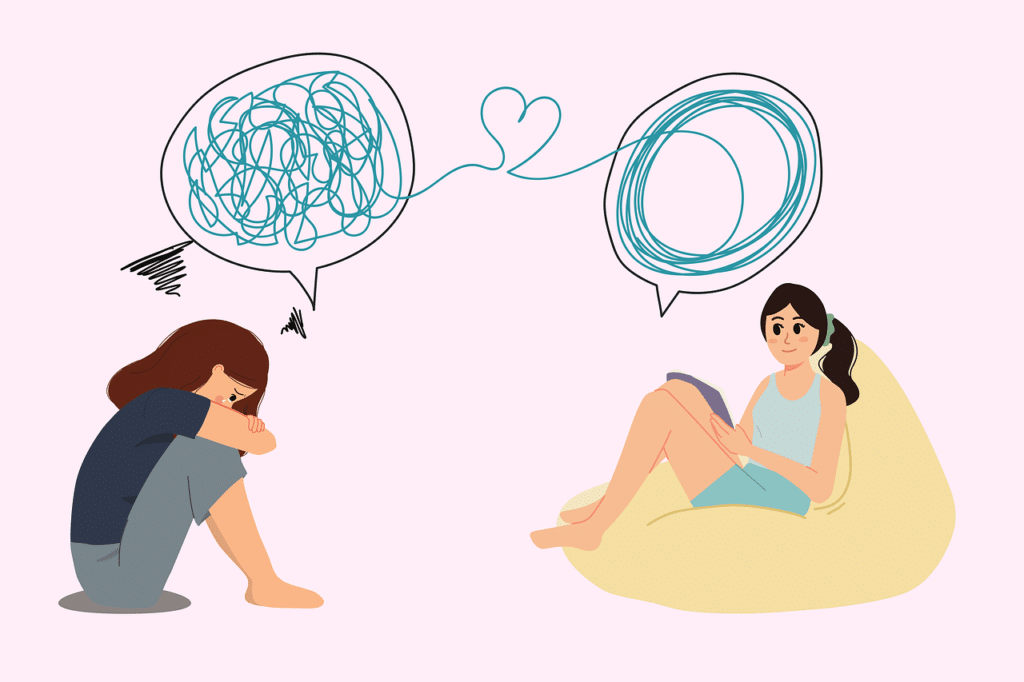
🌟We continue to explore cognitive biases. They influence our thinking and perception.

Come on, let's check out these interesting psychological distortions! 🤔✨
Types of Cognitive biases
1. All or nothing thinking (Dichotomous thinking): ⚫⚪
Example: If something is not perfect, it becomes completely worthless to a person. There are no transitions or shades, only two extremes are possible.
2. Overgeneralization: 🌐
Example: A person creates a general rule from a one-time event, and if he makes a mistake in one thing, he thinks that he cannot solve anything without making a mistake, that he is doing everything wrong.
3. Negative filter (Selective abstraction): 🚫
Example: Based on a negative detail, you classify everything as negative. If someone does not understand him in something, he thinks that the other person, or even anyone else, does not understand him at all.
4. Disqualification of positives: ➖
Example: Turning neutral and positive events into negative or ignoring them. E.g.: It is true that my colleague is nice to me, but only because his interests require it.
5. Premature or arbitrary conclusion: 🔮
Example: Mind reading and fortune telling. E.g.: Someone doesn’t pay attention to me, they must think it’s boring.
6. Magnification, minimization: 🔍
Example: The person exaggerates his faults and downplays his positive qualities.
7. Emotional logic: 💭
Example: Feelings determine reality. E.g.: Because I feel guilty, I must have done something wrong.
8. “Should” statements: ✔️
Example: Requiring a certain option, thereby excluding other options. E.g.: I have to do it, I can’t do it otherwise.
9. Labeling: 🏷️
Example: Naming a negative self-image. Eg: “I’m stupid.”

If you want to know more read the Harvard article on cognitive distortions
Also, instead of rating a given behavior, rating the person as a whole: 👤
Example: Someone once spoke to me angrily, he is an aggressive person.
Read more on the flaws of our brain
Recognizing and correcting these cognitive biases is crucial to our mental health. 🌈💖
 English
  Magyar