The Inner Battlefield: Why Our Desires and Rules Are Constantly at War, According to Freud
Have you ever felt like two voices were arguing inside your head?
One says: “Do it. Right now. You deserve it.”
The other warns: “You shouldn’t. What will people think? What are the consequences?”
According to Sigmund Freud, this isn’t just a poetic metaphor. Our personality is, in fact, the stage for an ongoing struggle between different psychological forces.
Freud’s Two Models: The Iceberg and the Inner Cast of Characters
Most people associate Freud with the famous iceberg analogy. This is part of his topographical model, which divides the mind into three levels: the conscious, the preconscious, and the unconscious.
However, when it came to explaining inner conflicts, Freud later developed another framework known as the structural model. It is based on three interacting components of personality:
The Id
The Id is the realm of instincts, desires, and impulses. It has little concern for rules, morality, or consequences.
Its message is simple:
“I want it—and I want it now.”
The Superego
The Superego represents social norms, moral values, conscience, and internalized expectations.
Its voice sounds more like:
“You shouldn’t do that. Be better. What will others think?”
The Ego
The Ego acts as the mediator between these two extremes. Its role is to balance instinctive desires with reality and social expectations.
If the Id is the gas pedal and the Superego is the brake, then the Ego is the driver.
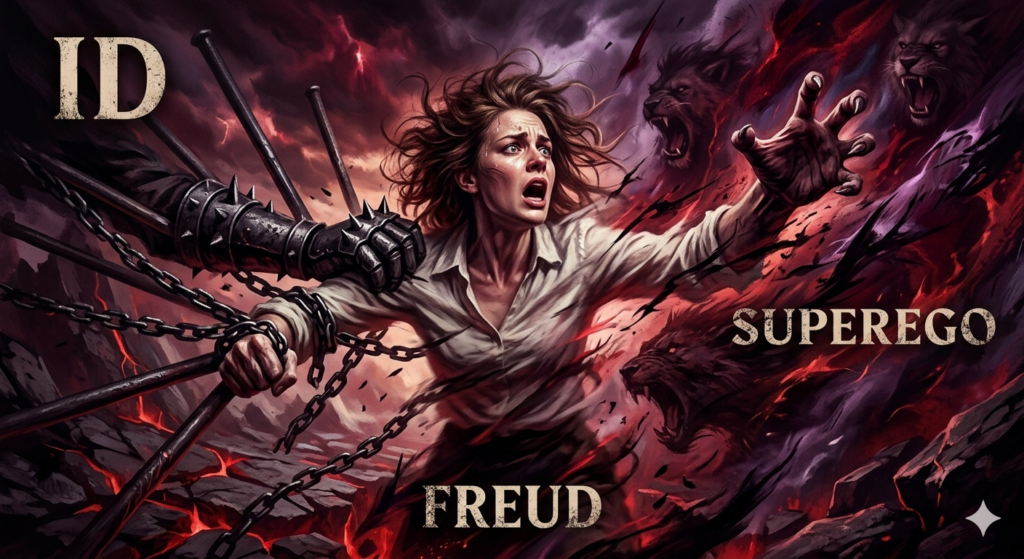
What Happens When the Superego Becomes Too Powerful?
At first glance, strict self-control may seem like a good thing. However, psychological research suggests that too much control can be just as problematic as too little.
Psychologists Jack Block and Jeanne Block introduced the concept of ego control in the 1980s. Their research identified individuals with what they called an overcontrolled personality style.
These individuals often:
- Struggle to allow themselves to make mistakes.
- Hold themselves to unrealistically high standards.
- Experience frequent guilt and self-criticism.
- Find it difficult to relax or enjoy the moment.
- Are more vulnerable to anxiety and depression.
In these cases, it is as if the Superego completely suppresses the desires of the Id. From the outside, such people may appear disciplined and successful, but internally they often live under constant pressure.
What Happens When the Id Takes Over?
The opposite extreme occurs when internal restraints become too weak.
In this situation, a person struggles to delay gratification, acts impulsively, and frequently chooses immediate pleasure over long-term goals.
This phenomenon is famously illustrated by Walter Mischel’s Marshmallow Experiment.
Children were given a choice: eat one marshmallow immediately or wait for a period of time and receive two marshmallows instead.
The experiment was never really about marshmallows—it was about self-regulation.
Children who found it more difficult to wait were later found to be more likely to struggle with impulsivity and self-control challenges. Modern psychology often describes this pattern as an undercontrolled personality style.
In these situations, the Id dominates the system, constantly repeating:
“Why wait until tomorrow if I can have it today?”

Psychological Health Is Not About Winning
One of Freud’s most enduring insights is that mental well-being does not come from one side permanently defeating the other.
The goal is not to suppress all of our desires.
Nor is it to obey every impulse that arises.
Instead, psychological health depends on the flexibility of the Ego—the ability to balance desires, values, and reality according to the situation.
Modern psychology often refers to this capacity as ego resiliency.
Perhaps this is the most timeless aspect of Freud’s legacy: the conflict itself is not the problem. The problem arises when one side completely silences the other.
A psychologically healthy person is not someone who never experiences inner conflict.
It is someone who can listen to both sides—and still make a conscious choice.
References
- Block, J. H., & Block, J. (1980). The Role of Ego-Control and Ego-Resiliency in the Organization of Behavior.
- Mischel, W., Shoda, Y., & Rodriguez, M. I. (1989). Delay of Gratification in Children. Science, 244(4907), 933–938.
- Freud, S. (1923). The Ego and the Id.
 English
  Magyar