Have you ever wondered what separates long-term happy couples from those who eventually choose to break up or divorce? Psychologist Dr. John Gottman studied couples’ communication for over 40 years in his famous Love Lab.
Gottman called these destructive patterns The Four Horsemen of the Apocalypse. If these horsemen permanently move into your daily life, they methodically consume the intimacy and trust between partners.
The good news, however, is that every horseman has its own antidote.
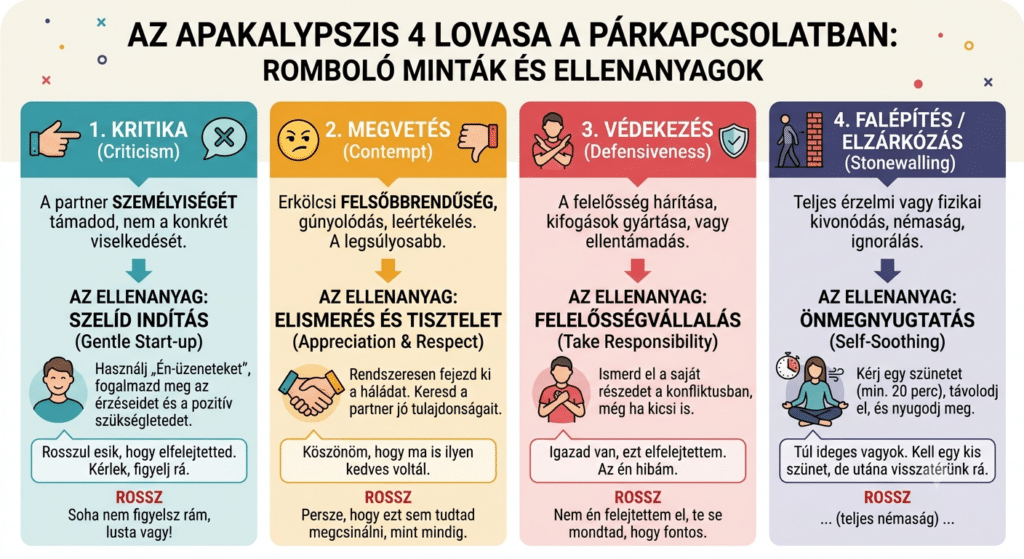
1. Criticism vs. Complaint
It is important to separate a complaint from criticism. A complaint addresses a specific action (“I’m a bit stressed because the dishes weren’t washed“). Criticism, on the other hand, generalizes and targets the other person’s character (“You never do anything, you are lazy and selfish!”).
- The antidote in action: Instead of saying: “You’re always late, you’re unreliable!”, try it this way: “I feel upset and anxious when you arrive late. Please let me know in advance next time if you’re running behind.” So if you have a complaint tell it to your partner without critisizing his or her personality. Use “I” statements.
2. Contempt: The Most Dangerous Horseman
According to Gottman’s research, contempt is the number one predictor of divorce. When you mock, laugh at, or roll your eyes at your partner, you are signaling: “I am more valuable, smarter, or better than you.” This behavior not only destroys the relationship but has also been proven to weaken the partner’s immune system due to chronic stress.
- The antidote in action: Even if you are going through a difficult period, consciously recall what you love about the other person. Small daily compliments and phrases like “Thank you for doing that” vaccinate the relationship against contempt.
3. Defensiveness: The Classic Trap
When we feel criticized, it is a completely natural reaction to defend ourselves. The problem is that defensiveness is actually a hidden accusation: “It’s not my fault, it’s yours!” By doing this, you cut off any chance of solving the problem together. Take responsibility for your actions even if it is partly causing the problem situation.
- The antidote in action: If your partner says you forgot to buy something at the store, instead of saying: “I had too much to do, you could have remembered it too!”, take responsibility: “You’re right, I forgot. I’ll write it down on the list next time.”
4. Stonewalling: When Flooding Takes Over
Stonewalling usually occurs when a person becomes overwhelmed by anger. Gottman calls this physiological flooding. In this state, the heart rate spikes, rational thinking shuts down, and the person flips into a defensive survival mode: they build a wall around themselves and stop responding to anything.
- The antidote in action: Do not try to continue the argument while angry, shouting, or shrouded in total silence. Say: “I’m too overwhelmed right now to see clearly. I need a 20-minute break, but we will come back to this and talk it through afterward.” During the break, don’t dwell on your grievances; instead, read, take a walk, or breathe deeply. After the break always talk it through.
Conclusion
There is no relationship where these horsemen don’t show up from time to time. The difference between happy and unhappy couples isn’t that happy couples never encounter the horsemen, it’s that they recognize them early and consciously deploy the antidotes.
Gottman, J. M. (1994). Why marriages succeed or fail: And how you can make yours last. Simon & Schuster.
 English
  Magyar